Find
Start with what does not work.
Persistent conflicts, recurring difficulties and unresolved demands reveal where established forms of coordination reach their limits.Research · Methods · Practice
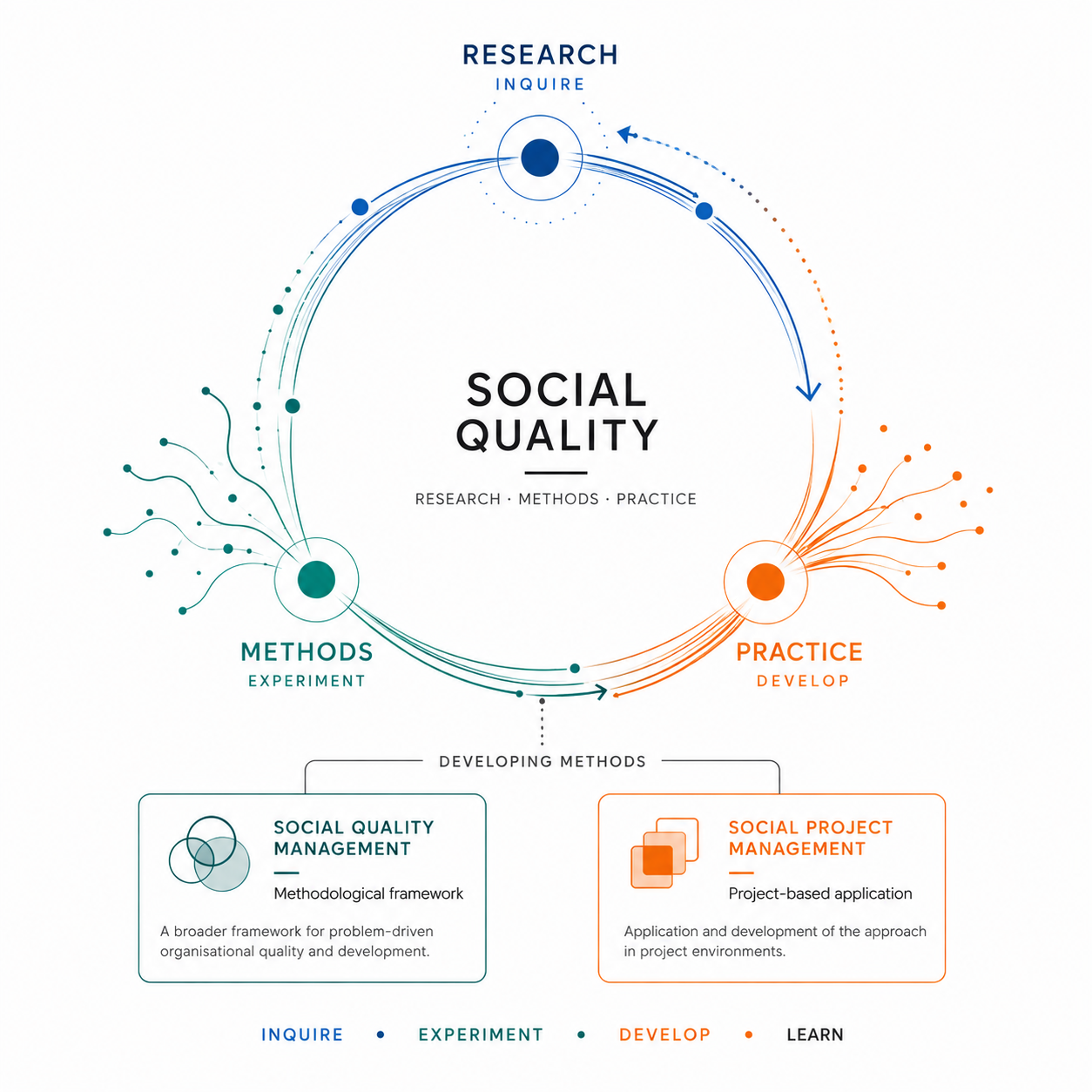
Social Quality develops problem-driven approaches to organisational quality through research, methodological experimentation and practical development.
For organisations facing problems that established quality systems cannot resolve.
The development cycle
They form an ongoing process in which problems become intelligible, alternatives become testable, and practical experience becomes part of further inquiry.
Why Social Quality?
Quality management begins with a reasonable ambition: to help organisations understand, evaluate and improve the quality of their work.
But sometimes the procedures designed to manage quality become part of the problem. More indicators, more documentation and more standardisation can consume substantial resources without resolving the underlying difficulties.
This is especially likely when organisations have to reconcile different — and sometimes conflicting — ideas of what good work requires.
The problem may be that the organisation has not yet found a workable way of dealing with the problem itself.
Social Quality starts from this point.
From problems to development
Start with what does not work.
Persistent conflicts, recurring difficulties and unresolved demands reveal where established forms of coordination reach their limits.Make the problem accessible to inquiry.
Use an appropriate theoretical and methodological approach to reconstruct what is happening in a controlled and instructive way.Develop possibilities rather than prescribe solutions.
Construct practical settings in which alternative ways of organising, coordinating and acting can be explored.Learn from what actually works.
Adapt what fails, consolidate what works and identify what can be transferred.A problem-driven approach
Not every problem requires the same theory, method or solution. Social Quality starts with the problem and develops a suitable way of investigating and working with it.
Established scientific approaches provide tools for controlled inquiry; practical experience determines what remains workable under actual conditions.
The method follows the problem — and is tested through practice.
Research · Methods · Practice
Investigate organisational quality.
Plural forms of evaluation, coordination, conflict, stabilisation and organisational transformation.
Explore research ↗Develop ways of working with difficult problems.
Social Quality Management and Social Project Management connect structured inquiry with practical experimentation.
Explore methods ↗Test and develop approaches under actual conditions.
Projects, pilots, training and transfer make emerging methods concrete and reveal what can hold in practice.
Explore practice ↗Social Project Management
Projects become difficult when different actors do not simply have different interests, but different ideas about what makes an outcome valuable, successful or acceptable.
A project may therefore be considered successful by one actor and problematic by another — without either evaluation being simply incorrect.
SPM asks: How can these differences become workable within project development?
Social Project Management addresses projects in which different evaluations become consequential for project development.
Rather than assuming that objectives, quality criteria and desirable outcomes are already fully defined, SPM examines how they are constructed, negotiated and translated in the course of a project.
SPM is developed through research, methodological work and practical experimentation. It does not replace project management; it adds a specific developmental perspective where evaluative plurality matters.
What matters to whom — and why?
Identify the different evaluations through which situations, problems and possible outcomes become relevant.How can different evaluations become actionable?
Develop forms in which heterogeneous evaluations can inform practical decisions without simply eliminating their differences.What has been stabilised — and what remains contested?
Examine which evaluations have become embedded in the project, which remain marginal and what this means for further development.When technological implementation becomes organisational and evaluative change.
Explore cases ↗When different organisational positions imply different ideas of successful change.
Explore cases ↗When the project has to develop its objectives while it is being developed itself.
Explore cases ↗Work in development
Some approaches are already developed. Others are still being tested.
Quality management as an epistemic and organisational problem.
Developing and testing a problem-driven methodology for projects in which different evaluations become consequential.
Investigating how organisations adapt when established practices encounter new technologies, requirements and forms of knowledge.
Practice has a history
Social Quality builds on experience beyond academic research — including project management, civic initiatives and organisational development.
From civic initiative to project platform.
Co-founded during the COVID-19 pandemic, Solidarburg developed from a crisis-oriented civic initiative into a project platform supporting several longer-term projects.
The experience informs the Social Quality approach: start from actual problems, develop workable structures, and let successful practices become more durable over time.
About Social Quality
Social Quality connects academic research, professional project management and practical organisational development.
Research, methodological development and practice are treated as mutually dependent parts of an ongoing process.
Social Quality was initiated by Simon Peters.
Its development is grounded in academic research, professional project management and experience in civic and organisational projects.